
Why regular, accredited valuations are crucial for adequate coverage
It will come as news to very few that the diamond market, both at wholesale and retail level has had a very turbulent few years. In the wake of international conflicts, tariffs, marketing catastrophes and the assimilation of synthetic diamonds into the market – what was once a relatively stable market has splintered, with some areas of the natural market really finding a niche, and others collapsing.
In terms of the valuation of diamonds – whether for insurance replacement at retail level, or alternatively at open market level for family division or probate – the importance of tracking and interpreting market data by a gemologically trained and registered specialist has never been more important.

The Synthetic Diamond Effect
Synthetic diamonds entered the commercial jewellery market in the 2010s. Challenging traditionally held beliefs about diamonds – particularly at the consumer level, these stones have grown more and more prevalent in the retail space. As the popularity of synthetic diamonds has increased, so have manufacturing methods – resulting in more and more affordable large, clean stones on the market. To simplify, this abundance of top grade synthetic stones in the market has resulted in a decrease in retail replacement value (with a negligible value on the open market). When synthetic diamonds are identified and assessed in isolation this is simple – however when they are spuriously sold as natural, mixed in with natural melee or mistaken for their natural counterparts – is when clients can encounter problems.
To confirm, at wholesale, the average pricing of a 1 carat round brilliant cut D-F colour, VS clarity synthetic diamond fell 90% in five years from 2021 to 2026. This exponential fall is not just for 1 carat stones, but echoed in differing sizes, from 0.70 carat to 2.00 carats. Natural diamonds, as a result of synthetic diamonds and other factors have fallen and slowed variably too, but none have fallen anywhere near to this extent.

In 2026, the National Association of Jewellers’ Institute of Registered Valuers changed their compulsory requirements for members to individually screen every single diamond with recognised and approved equipment. As members of the IRV, The Jewellery & Watch Consultancy use state of the art screening equipment on any diamond examined so that we can independently advise clients about their collections – and the subsequent values. We have in the last few years advised a handful of clients who had believed that they had purchased natural diamonds, only to be informed that they were the owners of synthetic diamonds.
Natural Diamonds that are Retaining and Increasing in Value
Whilst synthetic diamond wholesale prices are finding a floor, certain areas of the natural diamond market are once more enjoying a moment in the sun.
Perhaps as a direct response to the D-F, VVS and laser cut perfection of synthetic diamonds, the mid market appears to be shifting towards antique stones dating before the advent of modern cutting displaying character, naturally formed imperfections and a charming asymmetry. Cushion cuts, old mine cuts and old European cut stones, with large culets, bruted girdles and even ‘naturals’ on the girdle are favoured for these features.
Similarly, lightly tinted stones in the I-L colour range, whilst scorned a decade or so ago, are increasingly sought-out for their warmth, earned through natural nitrogen impurities and in certain cases crystal strain.

The Desert Rose Diamond – a pear-shaped, 31.68-carat, VVS1-clarity fancy-vivid-orangy-pink diamond sold for $8.8 million at Sotheby’s in December 2025.
Image Credit: Sotheby’s.
At the very top end of the market, in the 3 carat plus mark, high colour and clarity retains a steady value – and the accompaniment of laboratory reports or girdle inscriptions is becoming a necessity. As one might expect, unusually hued natural fancy-coloured diamonds are reaching stratospheric heights, with world records set at auction for two such examples in the last year alone – the Desert Rose Diamond pictured above, and the Ocean Blue Diamond, sold at Christies.
Our Advice for Natural Diamond Valuations

A Victorian diamond coronet cluster ring, circa 1860. Image Credit: Berganza.
Regular valuations of your Diamond Jewellery – For natural diamonds we would recommend a re-valuation every two to three years. This will ensure that your valuations are tracking the market, and that you are not over, or under insuring your items in the event of loss.
Another advantage to regular valuations is having a specialist assess the condition of your item. Although diamonds are the hardest naturally occurring substance, they are not immune to chips, nicks, or cleavage. Similarly, broken claws, loose settings and even snapped bands can all contribute very quickly to a loss.
Crucially, our valuations and assessments also include settings checks, giving you peace of mind that your stone is secure. As part of our service, we perform a condition check – we check settings and claws as standard, can advise when repair is needed
Use a Registered Valuer – Most insurance companies will only accept valuation documents from a registered valuer. A registered valuer offers an assurance of conduct at the highest level, with the expertise, equipment and methodology best suited to jewellery and watch valuations. We would recommend seeking the advice of a valuer registered with the Institute of Registered Valuers, the Jewellery Valuers Association, or both (as we at The Jewellery & Watch Consultancy are) to ensure that your document will indeed be recognised and accepted by your broker.
Check your Reports – Is the report present? If you have a laboratory report accompanying your diamond, from a reputable organisation such as the GIA (Gemmological Institute of America) it is extremely important to keep this safe and to hand for your valuation. The diamond grading for these reports is conducted under controlled, laboratory conditions, and also with the stone unset – so the grades stated in this report – once corroborated by our valuer independently – will be referenced in the valuation.
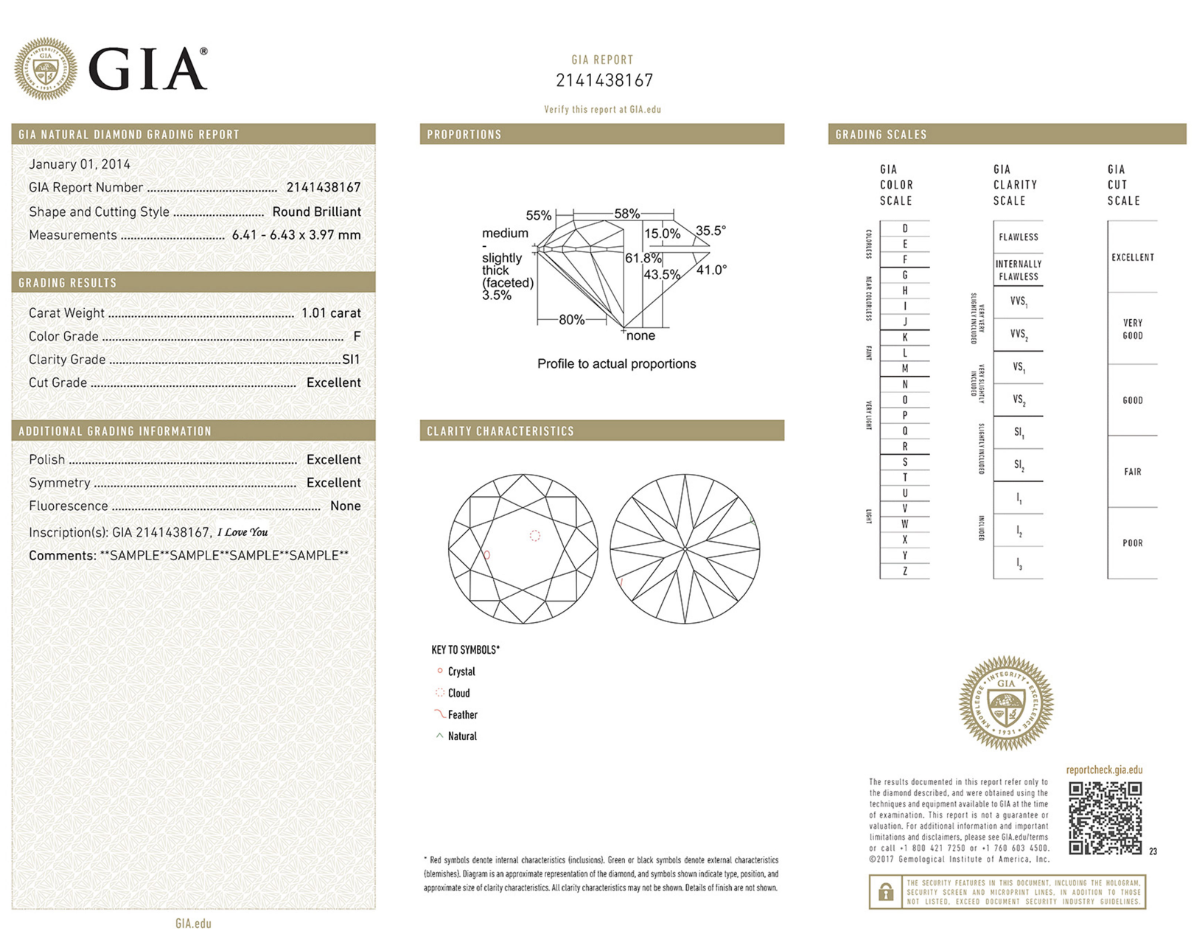
Is the report recent? Modern, up to date laboratory reports are unfortunately the only reports that we as valuers can recognise. A diamond report from 20+ years ago will in many cases present different information than a contemporary counterpart. Laboratory practices, equipment and grading standards are changing and evolving over time, meaning that grades ascribed decades ago may not be accurate according to modern standards. At The Jewellery & Watch Consultancy, we are happy to advise!
There is a place for synthetics!

A recent synthetic diamond trend – Alphabet Diamonds. Image Credit: K Kane.
Before besmirching synthetic diamonds as a whole, we urge you to recognise that there is a place in the market for both natural and synthetic. Many of our clients have seen the advantages of using synthetic diamond pieces as ‘holiday jewels,’ fashion jewellery, or replicas of their treasured natural pieces. Others have enjoyed expressing themselves with fun, fashion forward pieces crafted with synthetic diamonds – both within budget and making a statement!
Think Outside of ‘off the shelf’ – Have us Check All of your Pieces
Whilst some more ‘conventional’ diamond purchases of the last couple of decades, namely colourless, round brilliant cut, 0.50-1.50 carat may be experiencing a dip in value, other diamond jewels that you may not expect could well be worth more! Check inherited, heirloom and antique jewellery with our valuer, do not overlook diamonds that are ‘drawing’ colour, or indeed possess a rich character, such as briolette cuts or rose cut diamonds, these may now be worth more than you think!
For more information about obtaining a valuation of your diamond jewellery, contact us via enquiries@jewellerywatchvaluations.co.uk, or fill in our quick online form. We would be pleased to assist private clients, solicitors and executors in the valuation of diamond and coloured gemstone jewellery, as well as watches. Our service is nationwide, and we welcome enquiries from all over the UK.