
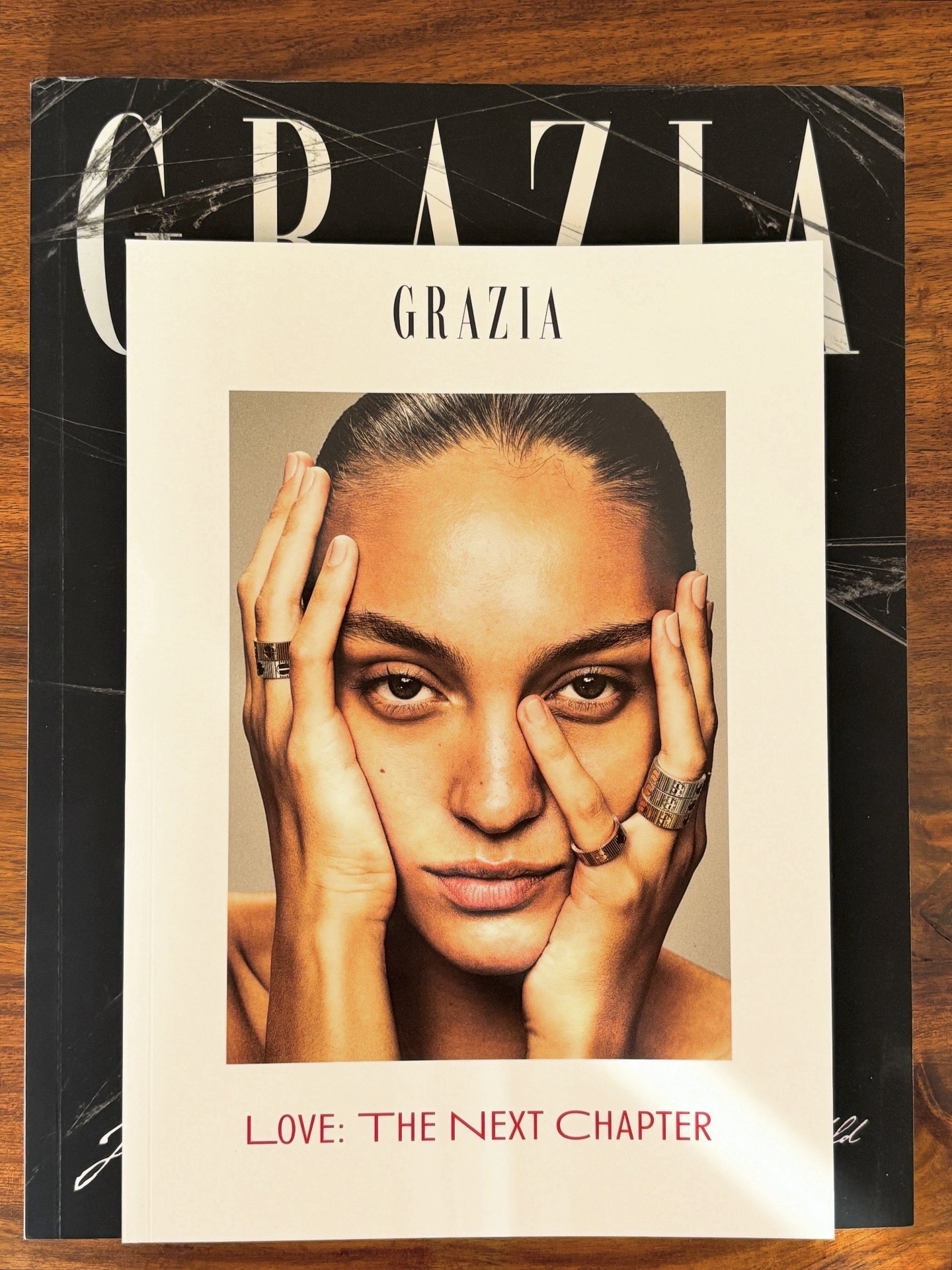
Featured in Grazia Magazine – Exploring the design heritage of Cartier’s iconic Love Collection, and the Maison’s next steps with the introduction of the flexible Love, Unlimited Collection.
Love, Unlimited
A new era of Cartier’s Love Collection
The Cartier Love Bracelet needs no introduction. A lasting icon of the jewellery world, the Cartier Love Bracelet has formed a key part of the zeitgeist for designer and sentimental jewellery from its conception in 1969 right up until the present day. With an ever-modern aesthetic, the Love bracelet has dominated Google with an estimated 350,000 searches per month – the most Googled piece of jewellery in the entire world in 2016 – and accrued a devoted celebrity following that spans decades to include Elizabeth Taylor, Diana Ross, Grace Jones, Andy Warhol, Victoria Beckham, and the Sussexes.
Earlier this year, Cartier once again affirmed the institution of the Love collection, winning a court case against fellow French jewellers Goussin Ltd for trademark infringement. Jewellery is inherently sentimental – think engagement rings, wedding bands, birthstones, the marketing is endless – yet Cartier is the only house to name an entire collection ‘Love,’ making it uniquely iconic in an industry fuelled by gestures of love.

The History of the Love Collection
The Cartier Love bracelet was created by the Italian designer Aldo Cipullo in New York in 1969. The son of a Neopolitan jeweller, Cipullo made his name in New York in the early 60s working for jewellers such as David Webb and Tiffany & Co, before joining Cartier in 1969.
Significantly for Cartier, Cipullo was their first designer to be singled-out, breaking their previously held policy of strict designer anonymity. Lending a bold, industrially inspired and rebellious approach to jewellery, Cipullo embraced the spirit of 1970s rebellion and romance with his self-described “modern handcuff.” Designed to be worn for extended periods of time by both men and women in romantic liaisons, the Love Bracelet was formed from two solid gold semi-circles, famously decorated with screw heads and intended to be attached (and removed) with a tiny screwdriver by a lover. Inspired by mechanics and tooling in his own workshop, Cipullo would design the equally industrial Juste Un Clou collection only two years later in 1971.
In 1970s New York at the height of the ‘free love’ era that rejected traditional monogamy and liberation, the Love bracelet was presented as a rebellious symbol of commitment and intimacy. The notion of attachment, and ‘locking’ a solid gold bracelet to a romantic partner became a bold statement in the era of experimentation.
This experimentation very much extended into bold and exuberant jewellery design of the time, from peers such as David Webb and Jean Schlumberger at Tiffany & Co. These pieces were typically designed in bold proportions, set in textured gold and adorned with unpolished crystals, large precious gemstones and hardstones. Amongst this backdrop, the Cartier Love Bracelet was a sleek, modern and clean outlier that challenged the norms of changing one’s jewels to each outfit with a permanent and lasting appeal.
Similarly set apart from Cartier’s own back catalogue of bespoke orders for tiaras and suites for high society clientele, the Love Bracelet was intended as a universal and modern symbol of devotion unlike any other. Discussing his cutting-edge design, Cipullo stated that “Love, has become too commercial, yet life without love is nothing – a fat zero. What modern people want are love symbols that look semi-permanent – or, at least, require a trick to remove. After all, love symbols should suggest an everlasting quality.”
And everlasting they have become, possessing a part of the cultural imagination ever since their inception. At the launch of the Love bracelet in 1970, twenty-five aspirational celebrity couples including Elizabeth Taylor and Richard Burton, Ali MacGraw and Steve MacQueen, and Sophia Loren and Carlo Ponti were reputed to have been gifted matching pairs. Defining a generation’s idea of modern love, these notoriously difficult to put on – and remove – bracelets have developed a lore of their own. The bane of airport security and New York Accident & Emergency rooms, where according to urban legend, after causing delays at X-ray machines, staff had to acquire their own supply of miniature screwdrivers in order to remove bracelets from patients admitted to hospital.
A canonical yet timeless jewellery design, the Cartier Love Bracelet has of course evolved over its fifty-six years, and the Maison has felt a duty to tread a careful balance between “nodding to the heritage but also looking to the future” as explained by Arnaud Carrez, Senior Vice President and Chief Marketing Officer of Cartier. With a design so iconic, it is much “more complicated, more challenging to enrich an existing collection than to design the new ones.” Previous evolutions of the collection include the setting of four and ten diamonds in the 1970s, white and rose gold versions in the following decade, and a new screw clasp system in 2011, allowing the screws to remain attached to the bracelet, and preventing the risk of loss during use.
Unveiled this September however, is the boldest iteration of the Love Collection to date, fittingly named ‘Love Unlimited.’

Love Unlimited
Arnaud explained to Grazia that “the philosophy at Cartier is to constantly transform, nurture our iconic collections,” with the notoriety of the Love Collection perhaps presenting the highest stakes of all. The Love Unlimited Collection is a true feat of innovation, as the result of over 100 trials and prototypes for Cartier during development. Presenting a new “love story without limits,” this collection embodies an ergonomic, second-skin version of the original bracelet.
Reinventing the rigid oval shape of the Cipullo’s bracelet, the Love Unlimited Collection embraces a fluid and flexible design. No longer centred on romantic attachment but on the beauty of self-connection, the Love Unlimited Collection consists of multiple gadrooned links and is fastened by an invisible clasp system. Elegantly reinterpreting the original Love Bracelet, “true to the original spirit,” with resplendent links and refined updates, this contemporary jewel is designed to retain the deeply personal symbolism of the Cipullo’s design, enriched with modern day considerations.
Easy to put on and take off by oneself, Armaud describes this innovation as truly “unlimited,” a user-friendly and inclusive design that can cater to all love – whether self-love, romantic love, platonic love, or simply a love of jewellery – “Love is one of the founding pillars of the Maison.”
The screw motif of Cipullo’s 1969 bracelet now takes an iconic and decorative function in the Love Unlimited collection, providing a striking yet recognisable detail, and adding a fresh perspective on the classic design with an updated clasp function. Available in yellow, rose and white gold, with bracelets and rings, the new Love Unlimited Collection writes a new chapter Cartier’s story, whilst crucially remaining “very true to the historic Love.” This is expressed beautifully in the modern-day interpretation of the original 1970s Love Bracelet’s advert, featuring two hands clasped, each wearing a Love Bracelet. The Love Unlimited advert features an identical pose, and incorporates both Cipullo’s design and the flexible, fluid links of the Love Unlimited bracelet, designed to be stacked together seamlessly to interpret and enrich each wearer’s very unique love story and express their individuality.
The notion for this collection was clear in our conversation with Armaud, the interpretation of the Love Unlimited bracelet and the sentiment behind it is entirely down to the wearer, and how they want to wear the piece to express themselves. Gone are the days of a prescriptive screwdriver wielding partner as in the 1960s and 70s, in favour of “expressing one’s love or expressing…your singularity, your personality.” This is entirely appropriate for the incredibly diverse consumers of the Love Collection, as Armaud points out, “the penetration of the interest of Love, it’s across the board, across regions and across age brackets.” The Love Unlimited Collection is not a ‘one size fits all’ approach, but a modern, fluid and ergonomic homage to a jewel that has a rich, significant and storied heritage.
Armaud concluded our interview with explaining the significance of Love Unlimited, with the idea of Love as a ‘pillar of the Maison.’ After all, Cartier was propelled through the love of three brothers in the early 20th century, and love of course features prominently in their collections, but is a very real part of the Maison’s purpose. “The attention to service and to treatment can be in events, can be in our boutiques, the sense of welcoming, also through our philanthropic actions initiatives [such as] the Cartier Women’s Initiative [or the] the Cartier Philanthropy Foundation.” Much like Cartier’s patronage of Cipullo in the late 1960s, the Cartier Women’s Initiative is empowering entrepreneurs to drive positive social and environmental change. Likewise, Cartier’s Philanthropy Foundation’s mission is to improve the lives of the most vulnerable communities in the world. “So, Love has a true meaning within Cartier, you know, it’s not, it’s not just a claim because Love, is of course part of jewellery, but it has a lot of meaning it has a lot of purpose at Cartier.” As far as we’re concerned, Love Unlimited is the perfect juncture between this internationally renowned Maison’s heritage, and its future.