
Hallmarking, Consumer Confidence and Valuations
A series of three to five small marks hidden away on the inside of a ring, the reverse of a brooch, the inside case of a watch, or to the post of an earring. Always containing the same set of information, in the same order. Whether stamped or laser inscribed, a set of hallmarks is a key identification feature on a piece of jewellery or a watch.
A hallmark is a frequently seen feature for a jewellery and watch valuer, and for the consumer it is an independent assurance of verification, protection and confidence. Although largely unseen and unnoticed whilst pieces are worn, these marks are of vital importance, and new consumer research demonstrates just how relevant that remains today.
YouGov Results & Consumer Perception of Hallmarking
Recent YouGov research commissioned by the British Hallmarking Council has highlighted a gap between the awareness and understanding of hallmarking.
The research found that just over half of UK consumers surveyed felt confident that they understood what a hallmark is and what it means.
When consumers were given an explanation of the purpose of hallmarking, 92% considered it important when purchasing precious-metal jewellery.
The research also found that 87% would be likely to look for a hallmark or ask about one before purchasing, while 86% valued independent verification by an Assay Office.
Furthermore, 89% felt retailers should explain what a hallmark means, and 85% said that clear hallmarking information at the point of sale would increase their trust in a retailer.
This YouGov survey indicates that consumers value the independent verification provided by hallmarking, once they understand more about what exactly it is.
What is a Hallmark?
According to the Cambridge Dictionary: “A hallmark is an official mark put on objects made of gold or silver that shows their place and year of origin and how pure the metal is that is used to make them.”
Currently, there are four active assay offices in the UK that independently test, verify and hallmark precious metal items. These are London, Birmingham, Edinburgh and Sheffield. Previous assay offices that are no longer active include Chester, Exeter, Glasgow, Newcastle, York, and Norwich – all of which may be seen on older and antique pieces. Hallmarking principally applies to gold, silver, platinum and palladium.

UK Assay Office Marks.
Under The Hallmarking Act (1973), hallmarks are legally required for:
- Silver items weighing 7.78 grams and over.
- Gold items weighing 1 gram and over.
- Platinum items weighing 0.5 grams and over.
- Palladium items weighing 1 gram and over.
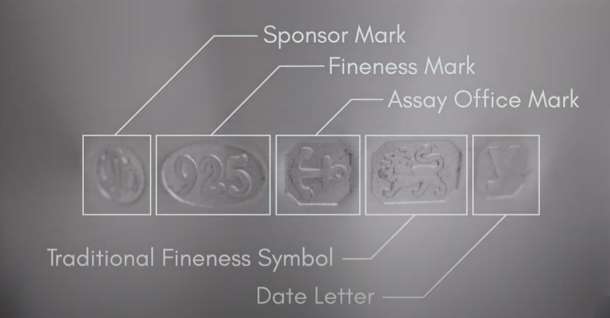
Full Hallmark Diagram. Image Credit: Birmingham Assay Office.
A full UK hallmark contains three compulsory elements, including the sponsor’s or maker’s mark, the metal and fineness mark, and the mark of the assay office.
A date letter may also be present following these three compulsory stamps, although this is optional.
As the Goldsmiths’ Company Assay Office explains, UK Assay Offices are independent of the trade, ensuring that the hallmark acts as “a trusted guarantee for both the consumer and the trade”.
The Hallmarking Act 1973
Whilst hallmarking in the UK has taken place for over 700 years, the UK’s current hallmarking framework is governed by The Hallmarking Act 1973, which has been amended and updated over time.
The purpose of hallmarking is to protect consumers against being misled about the precious metal content of an item.
For articles weighing over the specified weight thresholds above, UK law requires items sold as gold, silver, platinum or palladium to carry a legally recognised hallmark, subject to the exemptions set out in the legislation.
The legislation is therefore highly relevant to jewellery manufacturers, designers, retailers and consumers – but equally as important when it comes to valuations.
Hallmarks in Valuations
Hallmarks form an important part of the evidence considered when identifying and valuing jewellery. Where hallmarks are present, they provide key information about precious-metal content, assay office, origin, maker, and date of hallmarking, and may contribute to understanding a piece’s construction and history.
For The Jewellery & Watch Consultancy, accurate reporting of hallmarks is fundamental to professional valuation practice. Our accredited valuations record hallmarks diligently and exactly as found, in line with the Hallmarking Act 1973, relevant Hallmarking Guidance and applicable JVA and IRV professional guidance. The hallmark is one part of the examination: an independent valuation also provides an impartial assessment and verification of the item as a whole, for the specified valuation purpose and required value. Accurate identification, objective description and appropriate research ensure that the resulting valuation is reasoned, supportable and professionally defensible.